Saturday, April 9, 2011

Plantapalooza in Athens

Except for the State Botanical Garden, which had belatedly attached a .pdf to its web site, it was unknown what would be available where. But, remembering the horticulture club’s excellent buys last year, I decided to make that my first stop.

Of the plants on my list, the only one offered was a Yarrow (not the pomegranate I’ve been looking for, but a pink one: Dwarf Yarrow – Achilea millefolium ‘Cerlet’s Rose’). Paying $8 for a Yarrow seems a lot to me, but I did it anyway. Also bought a Columbine – Aquilegia ‘alpine blue’, since Columbines had been a recent Facebook discussion topic. The price, $5, seemed reasonable. Then I spotted a table with annuals, with 6-packs for $2 each and I bought 2 packs of Angelonia.

$17 so far, not bad.


Next stop: the UGA trial gardens. This was a situation of “well, I got here, so I might as well buy something”: an Ajuga (‘toffee chip’) and a Cuphea cyanea (‘candy corn’) - $5 each, which I thought was expensive, but there was nothing available for less than $5. Most plants were $10, $15 and $20 each. Dr. A was everywhere, with his bullhorn, recommending this plant and pointing out another. He said not to pay any attention to him, he often just talks to himself anyway, so I didn’t.

I had saved the botanical garden for last on purpose, thinking its plants were going to be more expensive than those sold at the other two locations (not true, it turned out), and this was a big mistake! Even though I got there shortly after 9 AM (the sales had all started at 8 AM), the one plant on my list that I really, really wanted (Carolina Jessamine) was all sold out! So, from a table staffed by Director Wilf Nicholls, I bought three tiny Amsonia hubrecthtii: $4 each.


By then, with barely a dent in my wish-list, I realized I should have bought all of the horticulture club’s Angelonia 6-packs, Angelonia having been my favorite annual for the past two years and once having paid as much as $5 for one plant at a neighborhood sale, so I went back to that location and was lucky enough to find two packs still on the table. Had they been in bloom, I think they would have been snapped up well before I returned, but an Angelonia before it blooms is nothing much to look at and shoppers in between my two visits probably had no idea what these plants were – or would become in summer.

So, now I had 31 plants for which I had paid a grand total of $39 – a good investment in my 2011 garden.

On the way home, I stopped at Shumake’s Daylily Garden and bought a few ‘Soft Summer Night’ – maybe the best purchase of the day, but it all depends, as is the case with everything a gardener does.

Thursday, April 7, 2011

Colorful Poppies

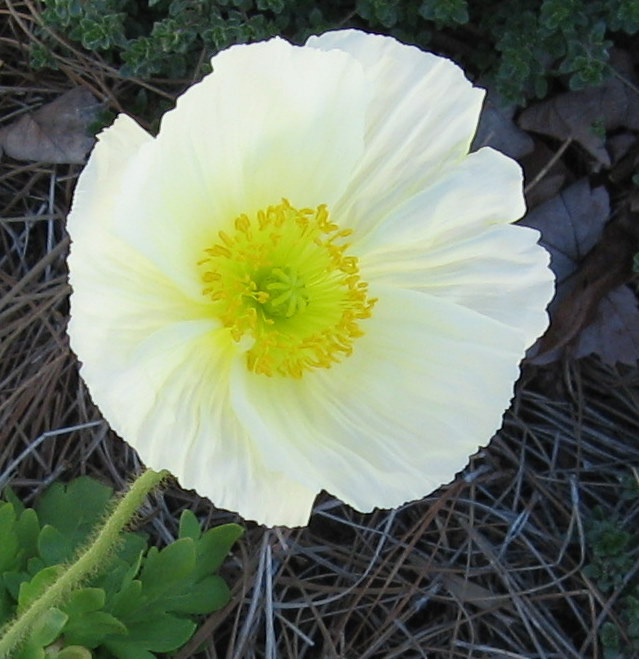
Monday night's huge storm left my Poppies unscathed and even though I am still not convinced that they are perfect for North Georgia gardens, I must admit that the colors are irresistible.


Thursday, March 24, 2011

Poppies - not a good choice for North Georgia gardens?

Perhaps your Poppies are doing well and I suppose that could be because they are in a sheltered sunny place. Mine are getting ample sun, but "sheltered" is almost impossible to achieve in my garden. So, for that reason I wonder if they are, in general, a good choice for North Georgia gardens. It's windy in March in this place and sturdier plants may be a better option. It's hard to beat these colors, though!


So far only two are in bloom; when I bought a flat last fall, the grower told me they were "mixed colors". Now we'll soon see what the others look like!

Monday, March 7, 2011

Daffodils


The photograph representing the title was taken March 6, 2011 at the State Botanical Garden of Georgia in Athens, where fields of daffodils welcome visitors in late winter.

Now blooming inside the SBG conservatory.

Barbara Barker & The Dirty Dozen

Yesterday, I attended a workshop by Barbara Baker, author of Container Gardening for Health. The workshop was about growing herbs in containers, and it was good, but it was the book that clinched the value of the workshop for me.


I had heard about and paid attention to The Dirty Dozen list before, but, as is so often the case in our busy lives, pretty much forgotten all about it. If you need the same reminder I got from Barbara yesterday, here it is:

Peaches
Apples
Sweet Bell Peppers
Celery
Nectarines
Strawberries
Cherries
Lettuce
Grapes (imported)
Pears
Spinach
Potatoes

These are the fruits and vegetables that have been identified to have the greatest pesticide residues (after washing!).

I don’t know about you, but I am going to investigate how I can organically grow a cherry tree and some peppers in containers. We’ve all got to start somewhere!

Tuesday, March 1, 2011

White Helleborus

I didn't know I had white Hellebores in my garden until the other day; I thought I only had pink ones. Delightful enough, but finding a white one (one, so far!) makes me treasure this plant even more.

This is what it looked like on Saturday.

And yesterday . . .

. . . and today! Isn't it a gorgeous flower?

Last night's storm has really cleared the air. The sky is as blue as can be today. The temperature about ten degrees below yesterday's, but still very pleasant for the first of March.

Saturday, February 26, 2011

As Spring Approaches . . .

It's an almost unbelievable phenomenon -- here we had a brutal winter (even snowed in for a week in January - that had never happened before in all my decades in Georgia) and now we are ending February with spring-like weather. What will March bring us?

The Hellebores are continuing a great presence in my garden. I read somewhere that they are an old, tough species of plant, having been known to grow, virtually undisturbed, in the same location for 40 or 50 years.


You will have noticed in plant nursery catalog that a Hellebore's flower is frequently photographed with the fingers of someone's hand underneath it. Logical! They grow low to the ground, with their faces turned down. So, other than cutting them, this is the only solution.


Last year, having received this bounty in 2009 from a gardening friend 50 miles away, only one plant bloomed (one bloom!); this year, that plant has several stems with multiple flowers. And a second plant has now gotten into the blooming act as well. I'm delighted!